12:30, the canteen, at the till
Efron’s dice: devised by the statistician Bradley Efron and made public by Martin Gardner in Scientific American in December 1970. A has the faces 4, 4, 4, 4, 0, 0; B, six threes; C, 6, 6, 2, 2, 2, 2; D, 5, 5, 5, 1, 1, 1. Of the 36 pairs of faces A beats B in 24, B beats C in 24, C beats D in 24 and D beats A in 24: winning is not transitive, there is no best die, only a best reply, and choosing first is the mistake. Four dice cannot do better all the way round: Zalman Usiskin proved in 1964 that two in three is their limit, that three dice stop at 0.618 and that no number of dice reaches three in four. It is a law of many throws, not of the next one: over twenty, the right die comes out ahead nine times in ten.
Objects · Four brass dice with no best one
Two in Three
CHF 78 working price
For deciding who pays for the coffee: let the other one choose first.
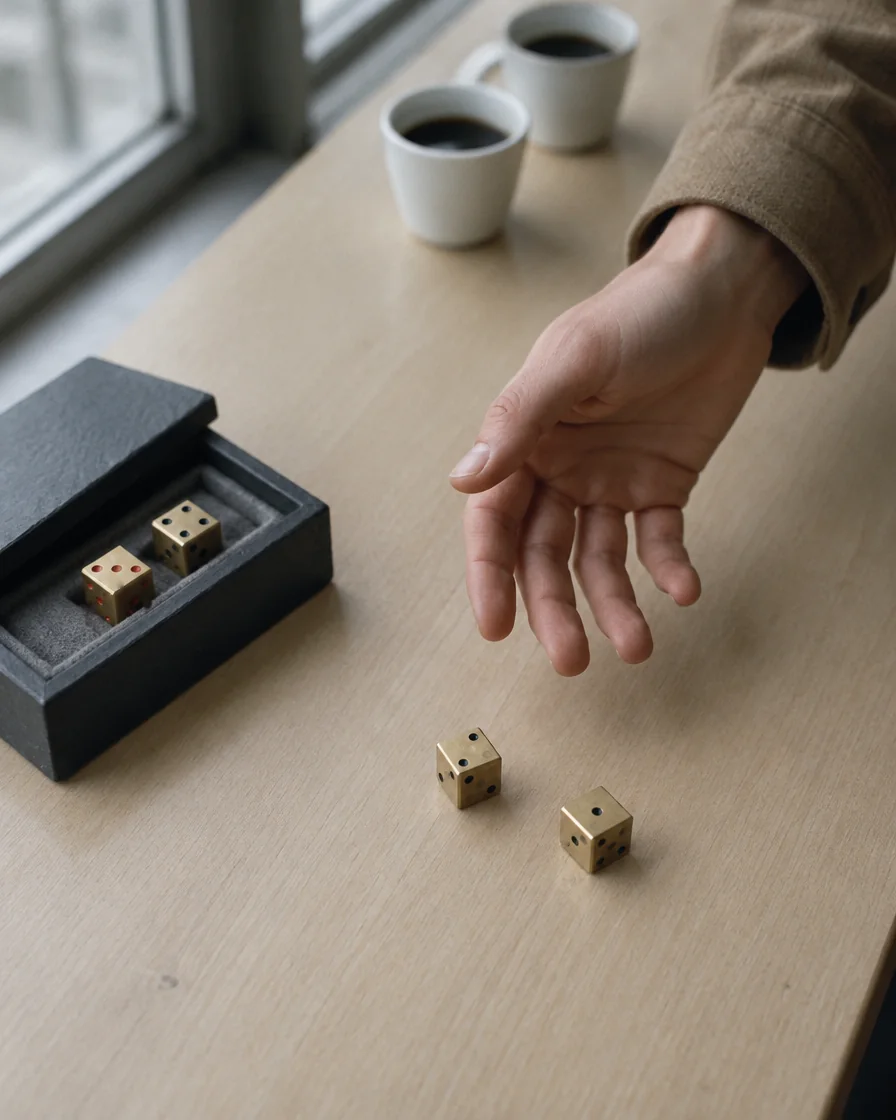
Four dice for settling who goes to the board, who referees the paper, who buys the coffee: each takes a die, both throw, the higher face wins. Let the other person choose first. Whichever die they take, one of the three that are left beats it two throws in three.
A study: nothing can be ordered yet. The photograph is a generated image, not a picture of a made piece or of a real person.
- Four cubes of solid brass, 16 mm, about 35 g each, milled square within 0.05 mm, the edges broken alike by hand
- Pips drilled 1.8 mm across and 0.3 mm deep, 72 in all; a blank face is a nought. The most a face gives up is a thousandth of the die’s weight, so the dice stay honest
- The pips are blacked on three dice and filled with vermilion enamel on the fourth, the die of six threes. It never varies, and still wins two throws in three against one neighbour and loses two in three to the other
- A slate box lined in felt, the four in a row in the order of the circle: each beats the one on its right, and the last beats the first
- No numerals anywhere; the number is stamped inside the lid