A cabinet of instruments.
Sixteen instruments for the board, the desk, the pocket and the hours after. Most do a job; every one shows one result, in its shape or in the way it moves, and is there to be tried. The chalk box, the pencil box and the notebook carry the mark; the rest carry a number at most.
A study: prices are working values, nothing can be ordered yet, and the photographs are generated images.
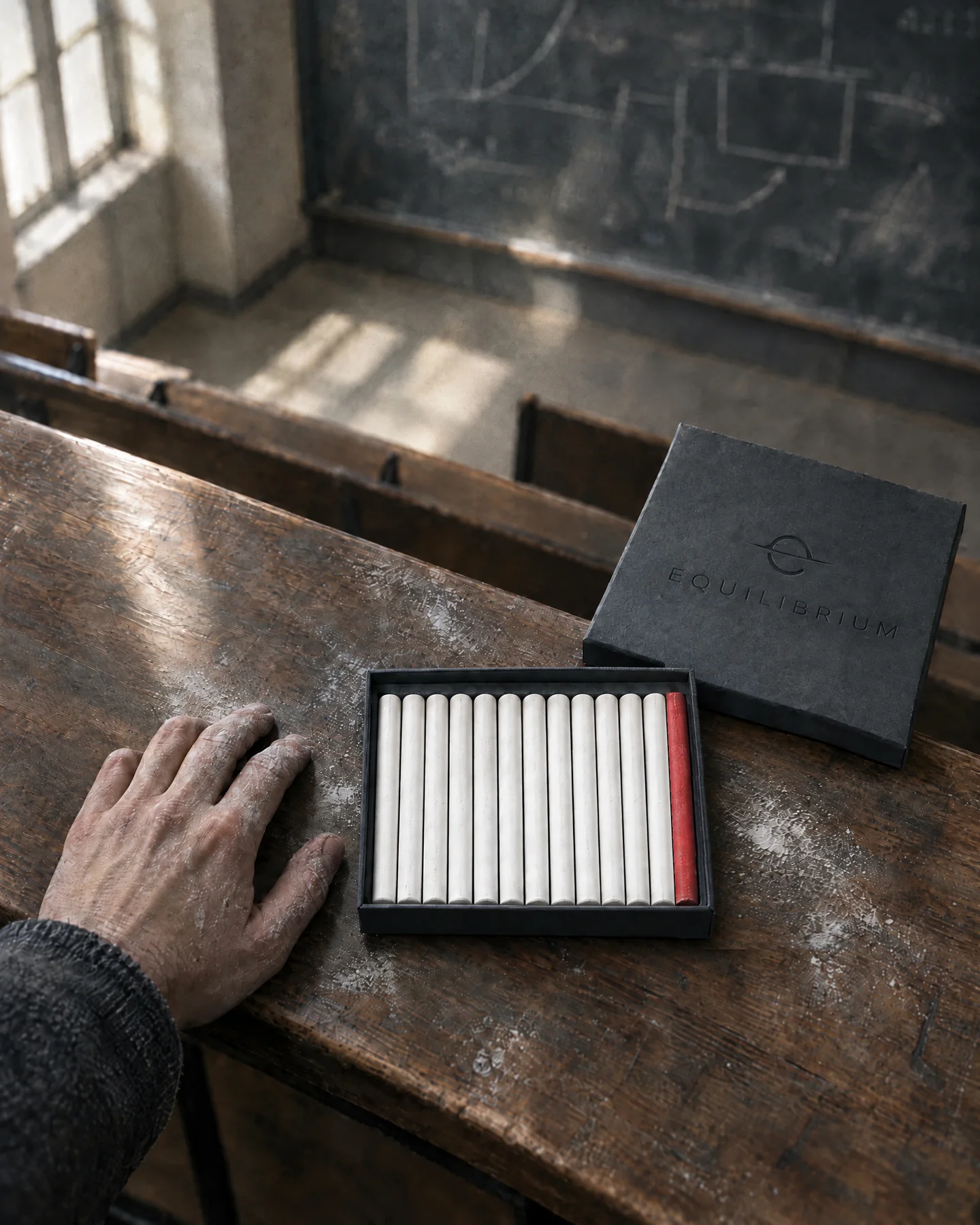
Box of chalk
Twelve and One
CHF 28
Twelve sticks of white for the working, one of red for the answer.
A tally: twelve strokes, then one more. In old manuscripts the line that matters is written in red, the rubric, from the Latin for red ochre. Use it once a board.
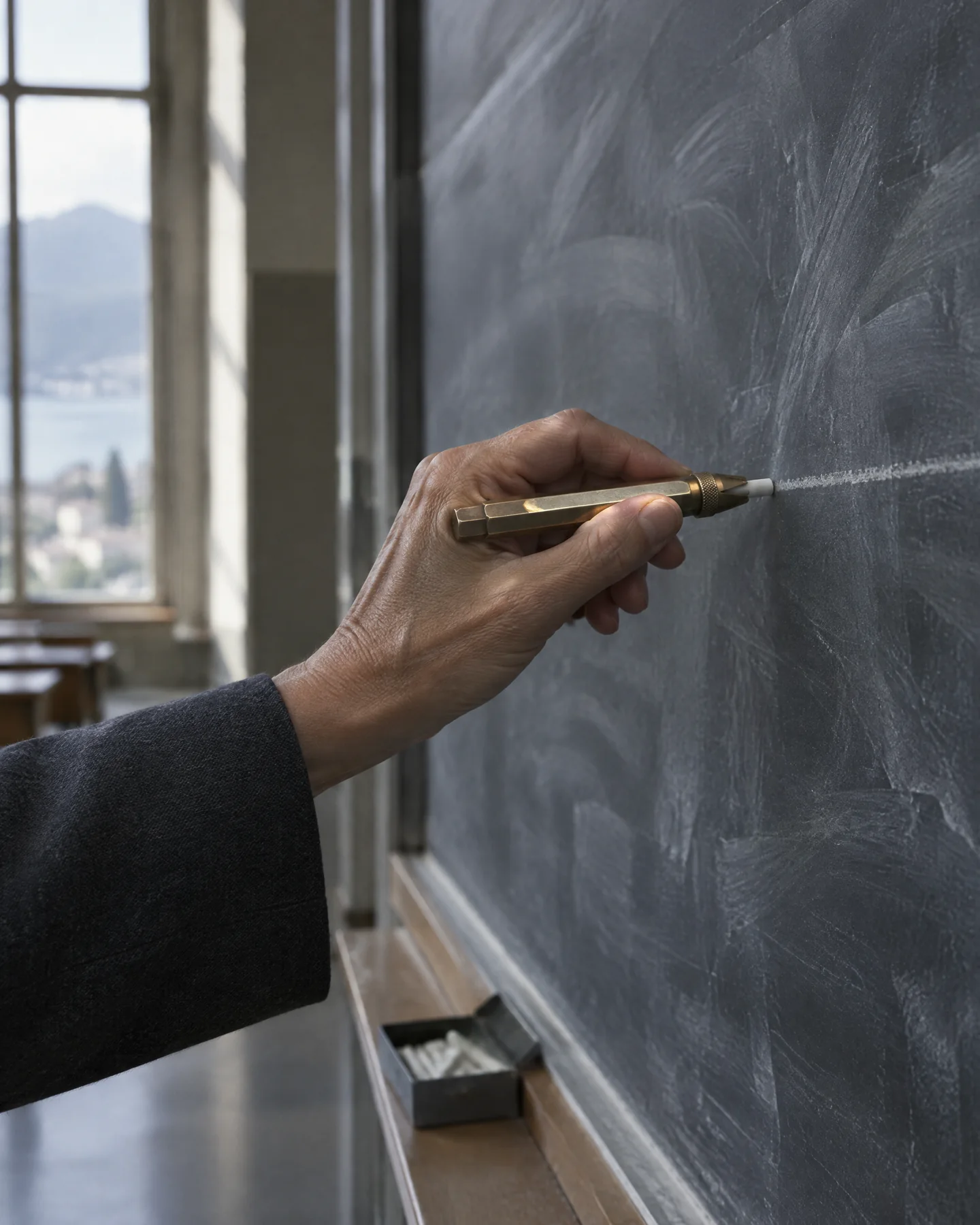
See the objectSolid brass chalk holder
Three Jaws
CHF 58
A solid brass holder for the chalk in the box. Three jaws close on the stick and centre it, whatever is left of it. It stands in the jackets’ chalk slot, where the two sticks would go.
Three points that are not in a line lie on exactly one circle: Euclid, Book IV, Proposition 5. Three jaws at 120°, closing together, therefore agree on one centre, and a stick of any width is held on the holder’s axis: the principle of the lathe chuck. Two jaws would let it slip sideways; four have to be set one by one.
See the objectBoard straightedge with a spirit level
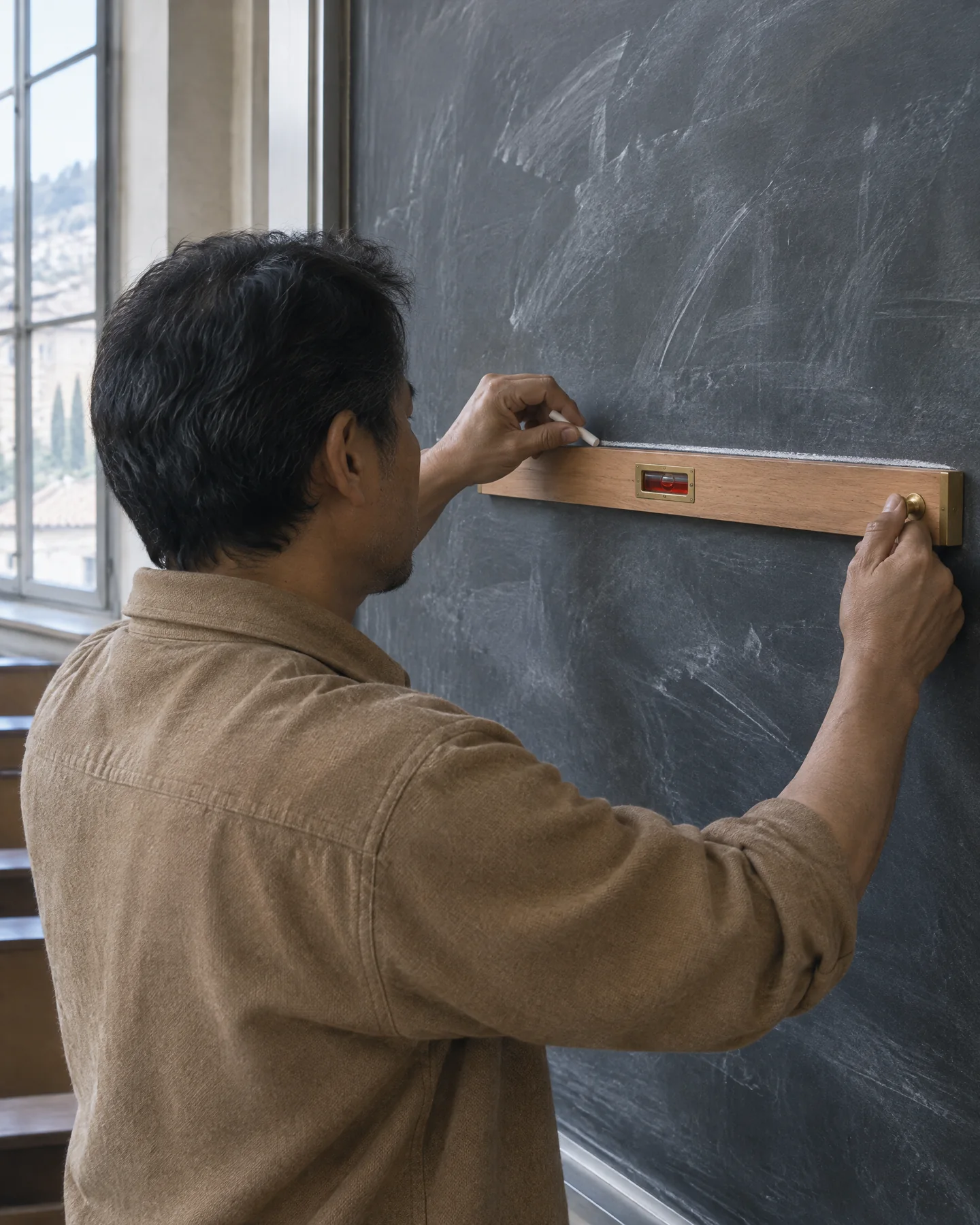
Level Rule
CHF 85
A straightedge for the board, in pear wood with brass ends and one glass vial let into its face. No graduations: on a blackboard the unit is whatever you say it is.
The vial is not straight. It is an arc of a large circle, and the bubble rests at the highest point of the arc, because that is where the liquid’s weight puts it: an equilibrium you can watch arrive. Tilt the rule through an angle θ and the bubble runs s = Rθ along the glass, so the sensitivity of a level is nothing but a radius. This one is ground to R = 2 m: a slope of one millimetre in a metre moves the bubble two millimetres.
See the objectBrass sounding plate, with bow and sand
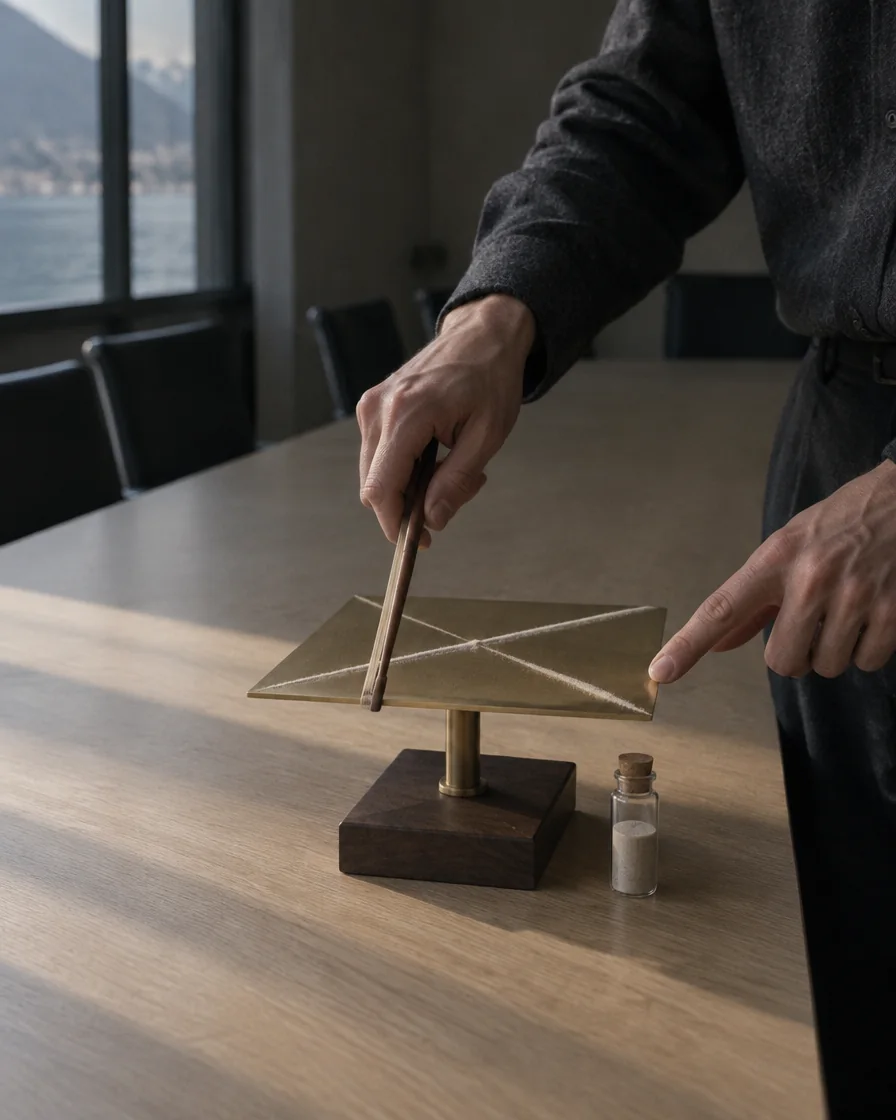
Quiet Lines
CHF 240
A square plate of brass on a post. Rapped with a knuckle it rings long enough to end a seminar. Dusted with sand and bowed on its edge it sings one note, and the sand runs to the lines where the plate is not moving.
A plate sounding one note is a standing wave: parts of it rise while their neighbours fall, and between them run lines that do not move at all. Sand is thrown off whatever moves and comes to rest on those lines: Ernst Chladni showed it in 1787. A fingertip on the edge chooses the figure, by forbidding motion where it rests: bow the middle of a side with a finger on a corner and the sand draws the two diagonals; bow near a corner with a finger at the middle of a side and it draws an upright cross through the middles of the sides, a little under a fifth lower. Napoleon had the Paris Academy offer a prize for the theory: Sophie Germain won it in 1816, Kirchhoff set the edge conditions right in 1850 and Ritz computed this very plate in 1909. The formula here is the simplest with the right symmetry, exact for a plate whose edges may slide but not tilt and close for free ones; its red diagonals are exact for both, by symmetry alone.
See the objectSand glass, 45 minutes
Office Hour
CHF 95
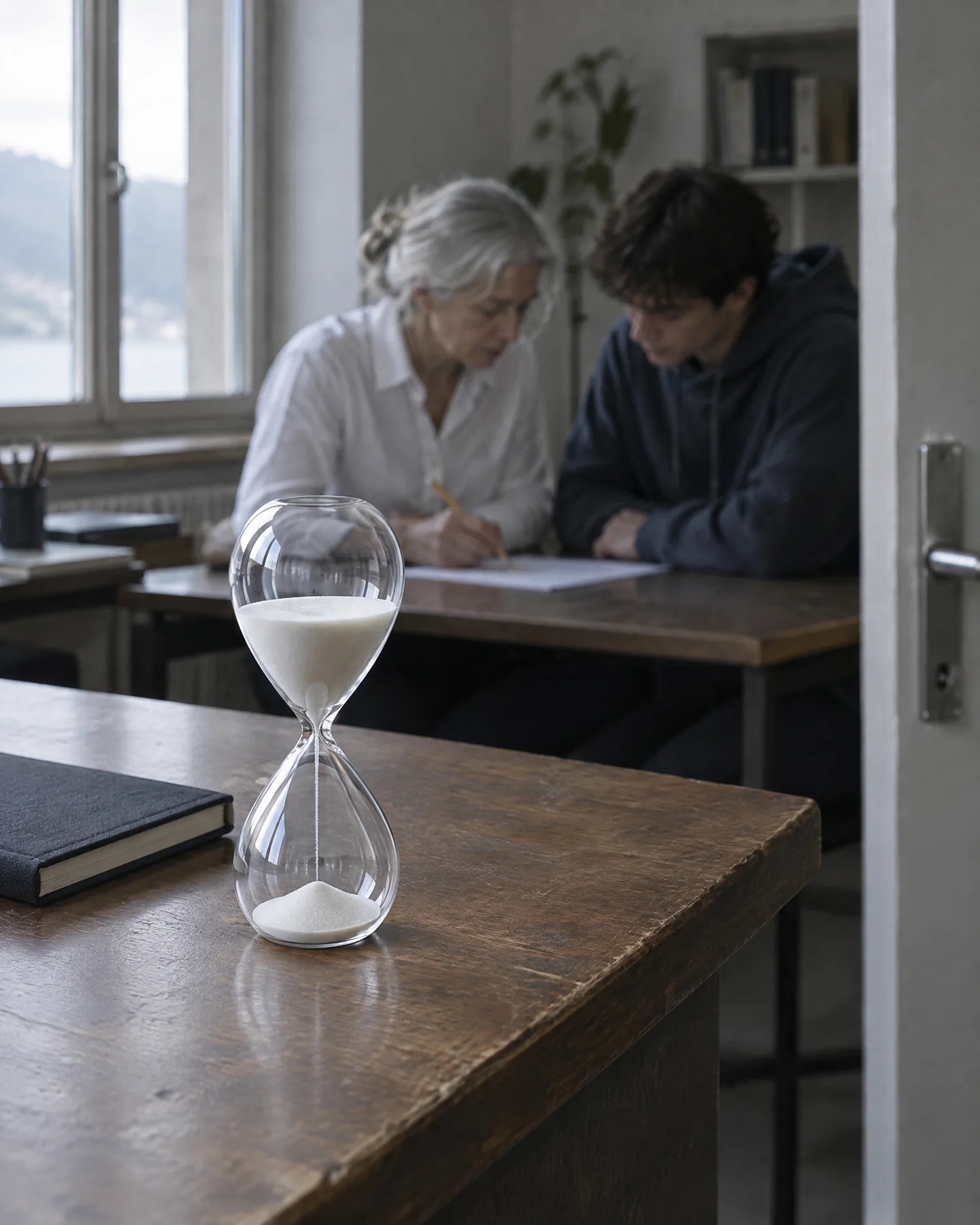
The academic hour is forty-five minutes. So is this: one piece of blown glass, chalk-white sand, nothing to wind and nothing to charge.
Water runs out of a vessel more slowly as its level falls: Torricelli, 1643. Sand does not. The grains above the neck lean on the glass and on one another, so the neck never feels the height of the column, and the flow depends on the width of the neck alone: Beverloo’s law, 1961. That steady flow is why half the sand is half the time. Drawn here: sand, the straight red line; and water in a straight-sided vessel that would empty in the same time, a parabola that agrees with the line only at the start and at the end.
See the objectCycloid track in walnut, two steel balls
Any Height
CHF 150
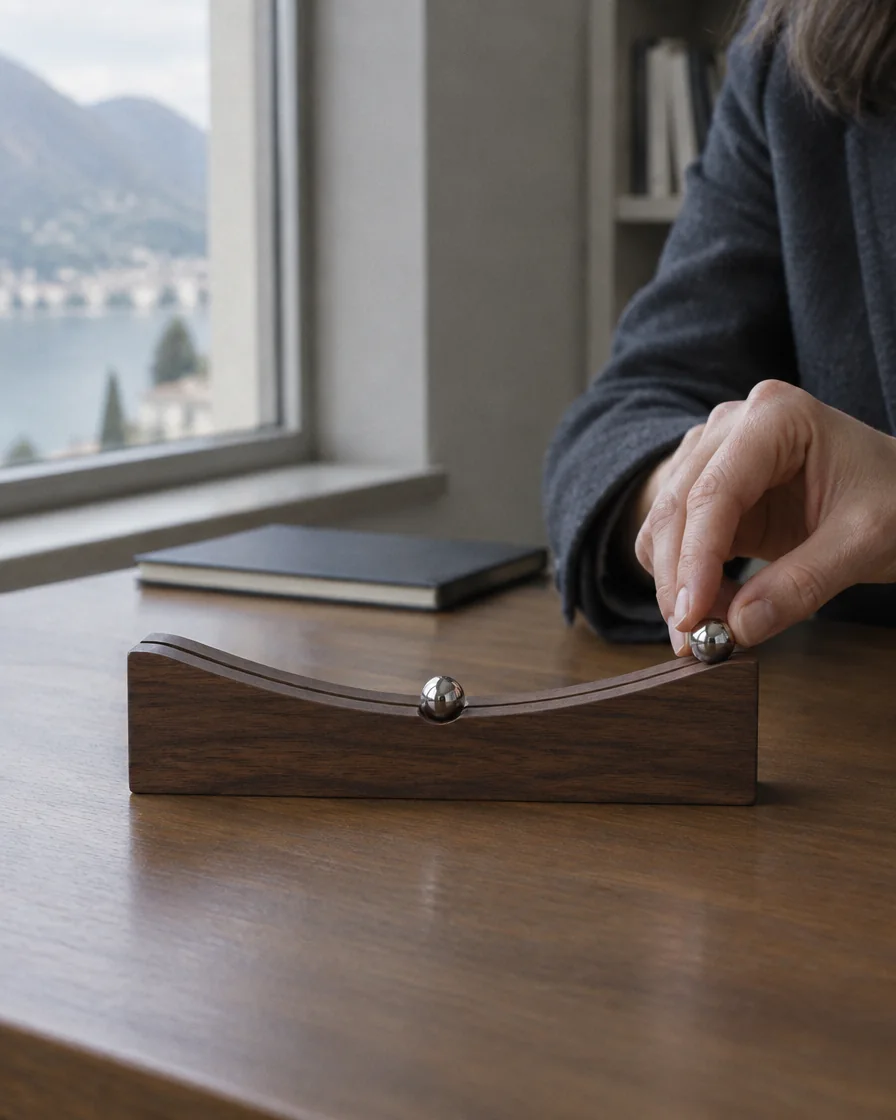
A block of walnut with a dip cut along its top edge, and two steel balls. Let one go from the rim and the other from anywhere lower on the other side: they meet at the bottom, every time. Left alone, one ball swings once a second, however small its swing has become.
The dip is a cycloid, the curve drawn by a point on a rolling wheel, turned upside down. Along a cycloid the height above the lowest point grows as the square of the distance still to run, so the pull back towards the bottom is exactly proportional to that distance: twice as far to go, twice the pull, the same time. Christiaan Huygens found it in 1659, looking for a clock that would keep time at sea, and printed it in 1673. A pendulum swings on a circle, where the same is only nearly true: let go as high as the rim of this track, a ball on a circle arrives about 2% late. A ball that rolls changes one number and nothing else, since rolling makes it 7/5 as hard to move on any track: the fall takes π√(7a/5g), a quarter of a second here, from any height. The same curve is the quickest way down, Johann Bernoulli’s challenge of 1696; and it is the Double Pendulum turned inside out: there the same start gives different ends, here different starts give the same end.
See the objectBrass card stand that rights itself
Five Eighths
CHF 110
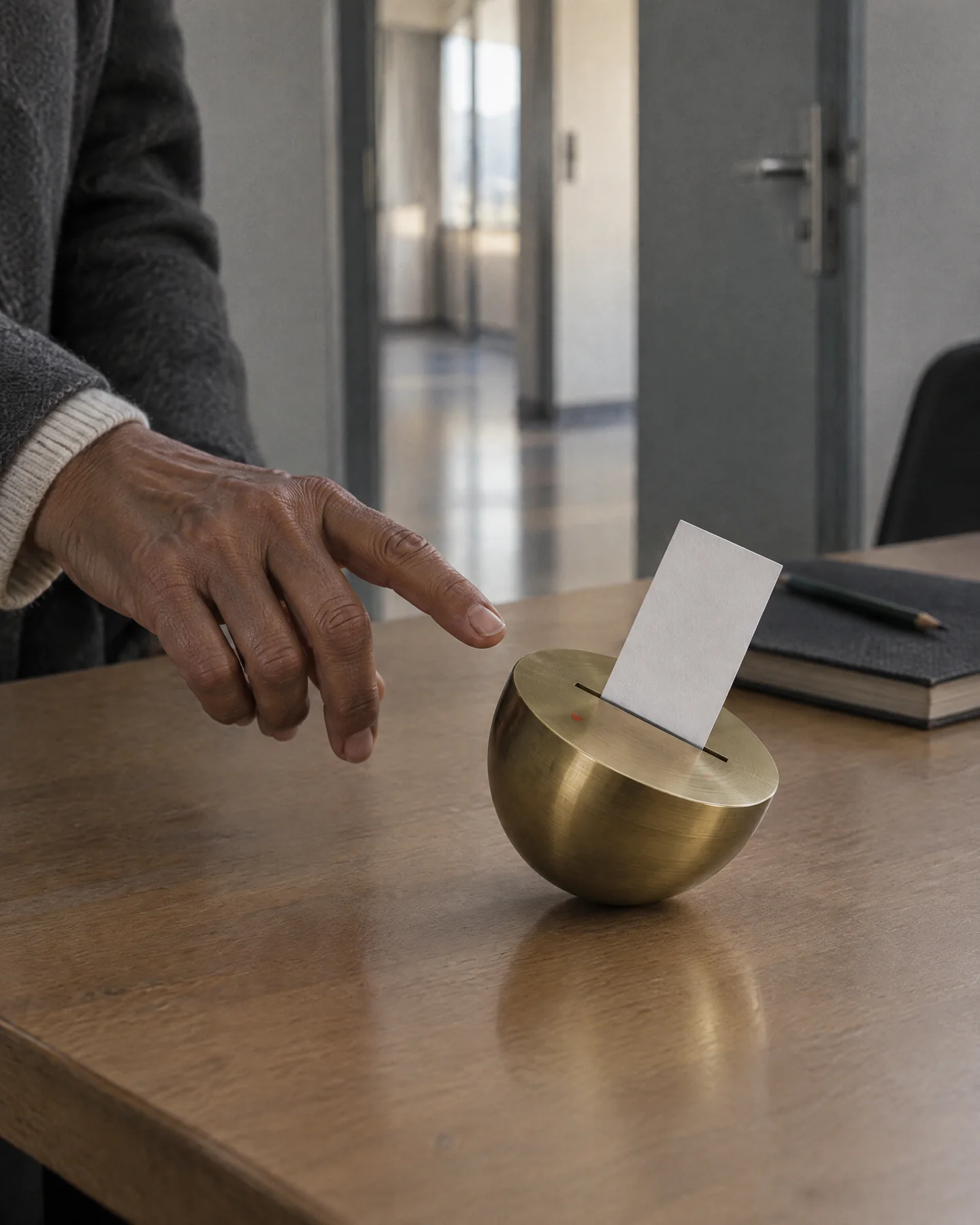
Half a ball of solid brass, round side down, with a slot across its flat face for one card. Push it over and it comes back. It has nowhere lower to go.
Archimedes placed the centre of gravity of a hemisphere on its axis, five eighths of the radius from the pole. Stood on its round side, that point is lower than the centre of the ball, so any tilt lifts it: as the brass rocks, its centre of gravity runs along the shallow trough drawn here, which has one lowest point. Upright is that point. A minimum of potential energy is what a stable equilibrium is, and it is the kind we are named after.
See the objectFour brass page weights
Overhang
CHF 120
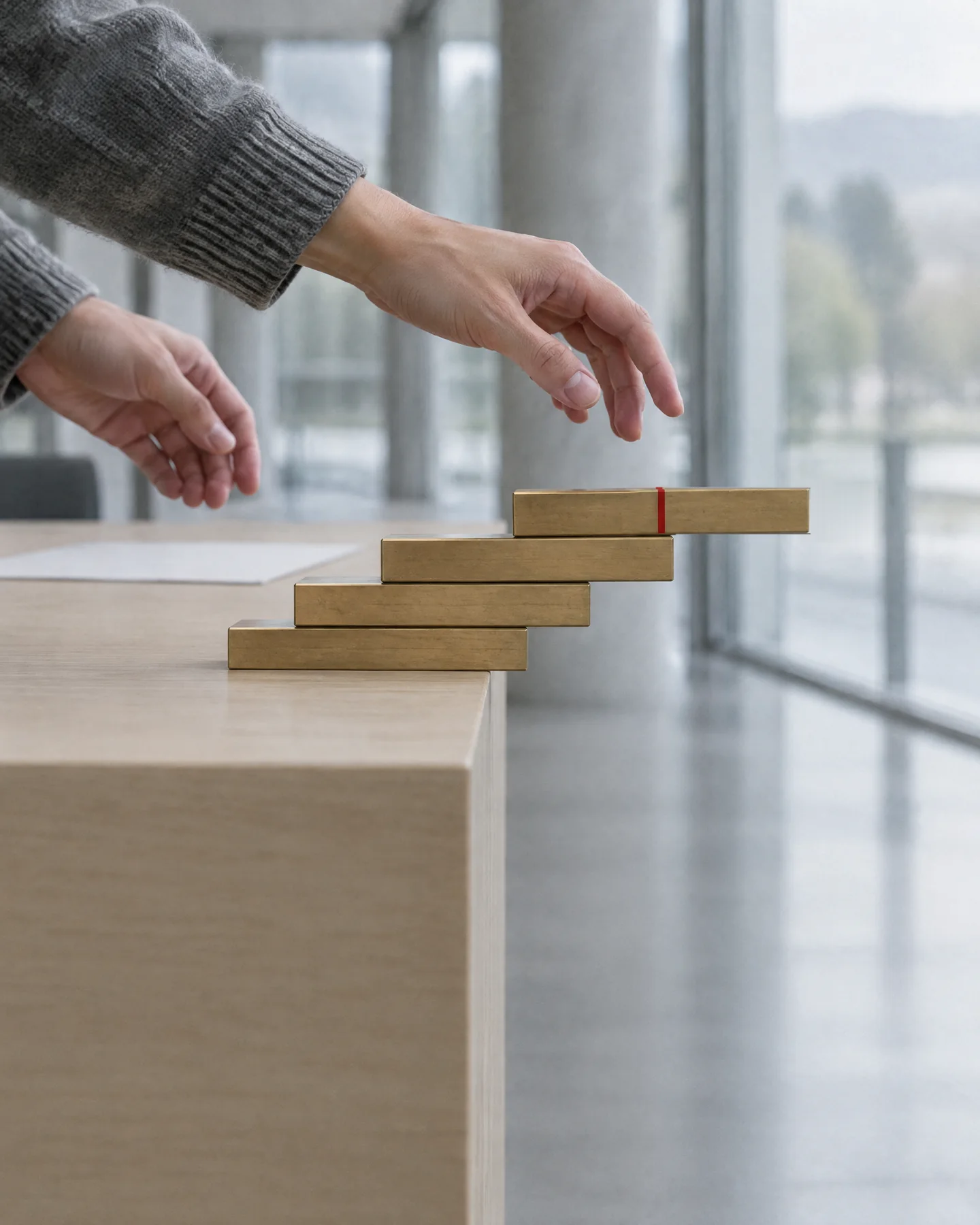
Four identical bars of brass. Their work is to hold paper flat. Stacked at the edge of a desk, each pushed out as far as it will go, the top one ends up wholly past the edge, and stays there.
Slide the top bar out until it is about to tip: half its length. Slide the two together over the third until they are about to tip: a quarter more. Then a sixth, then an eighth. Four bars reach 25/24 of a length beyond the edge, so the top one has nothing under it but brass, and the centre of gravity of all four sits exactly above the edge. The sums are half the harmonic series, which grows without limit: with enough bars the overhang is as long as you like. Zeno’s series, on the polo, stops at one. This one never stops, though it is in no hurry: two lengths take thirty-one bars.
See the objectPencil tray cut from slate
Stadium Tray
CHF 95
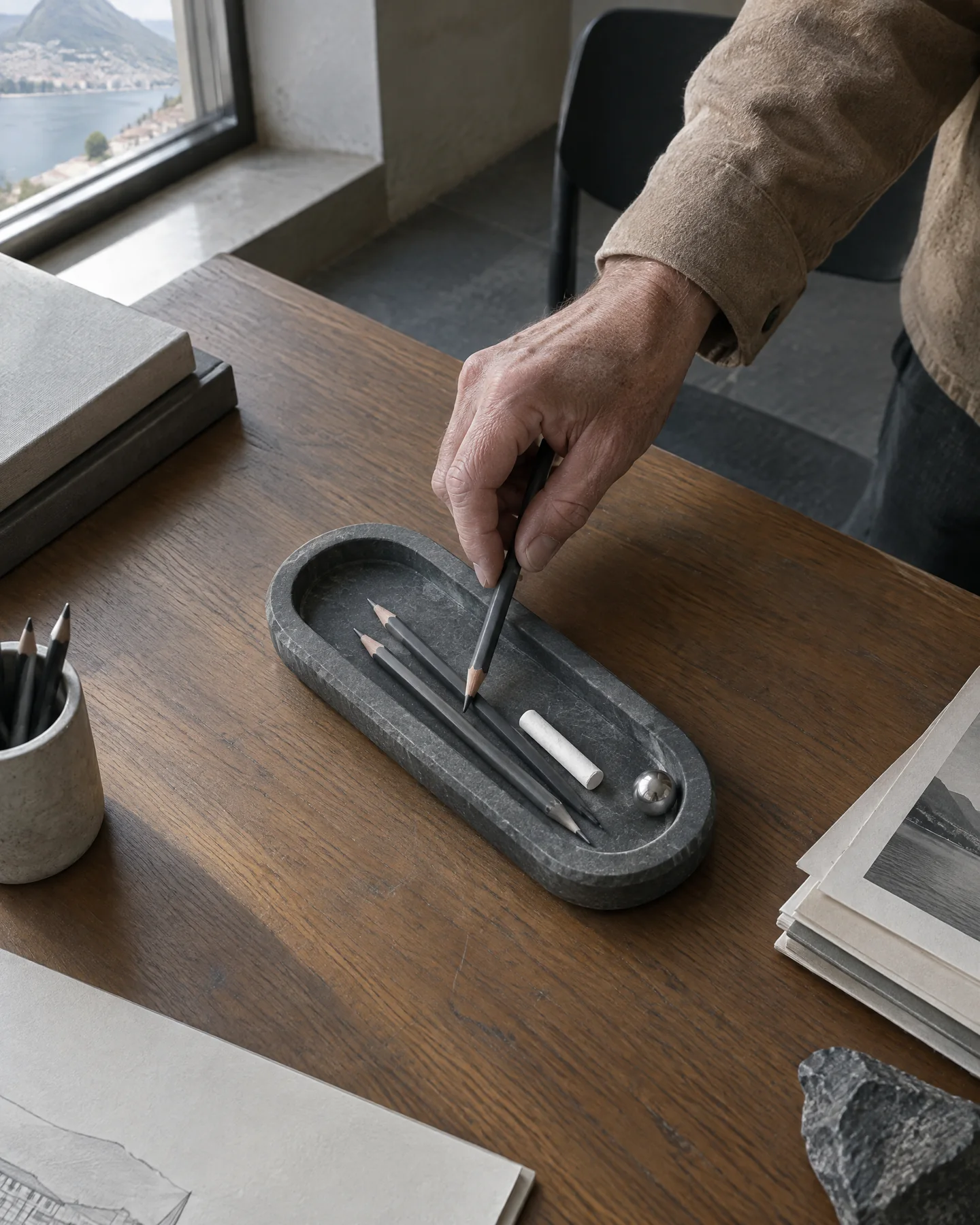
A pencil tray cut from the stone of blackboards, in the shape of a running track: two straights and two half-circles. It comes with one steel ball. Roll the ball, and you have one of the simplest chaotic systems there is.
A ball on a table with no pockets and no friction, bouncing as light does off a mirror. If the table is a circle the motion is orderly forever. Pull the circle apart and join the halves with two straight sides, however short, and it is not: Leonid Bunimovich proved in the 1970s that in this shape two shots a hair apart are soon unrelated. No corners, no obstacles, nothing rough; the chaos is in the outline alone.
See the objectDot grid, A5, 192 pages
Lab Notebook
CHF 36
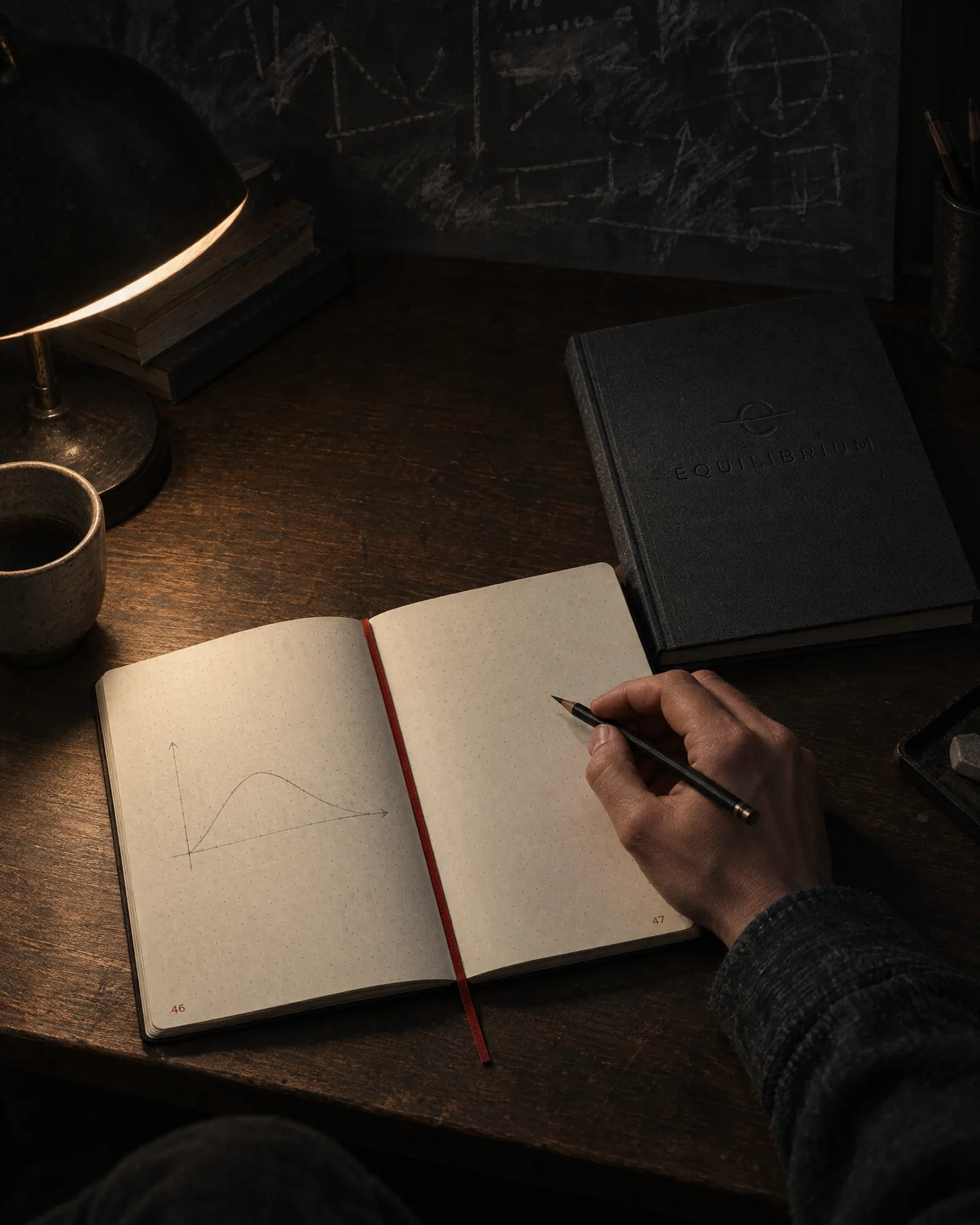
The notebook this site is drawn in: dot grid, page numbers in red, a ribbon to keep the place. Every inside pocket in the collection is cut for it.
A grid of dots is the integer lattice. The red line is a walk on it that never visits a point twice; nobody has a formula for how many such walks there are with n steps.
See the objectBundle of seven pencils
Six and One
CHF 24
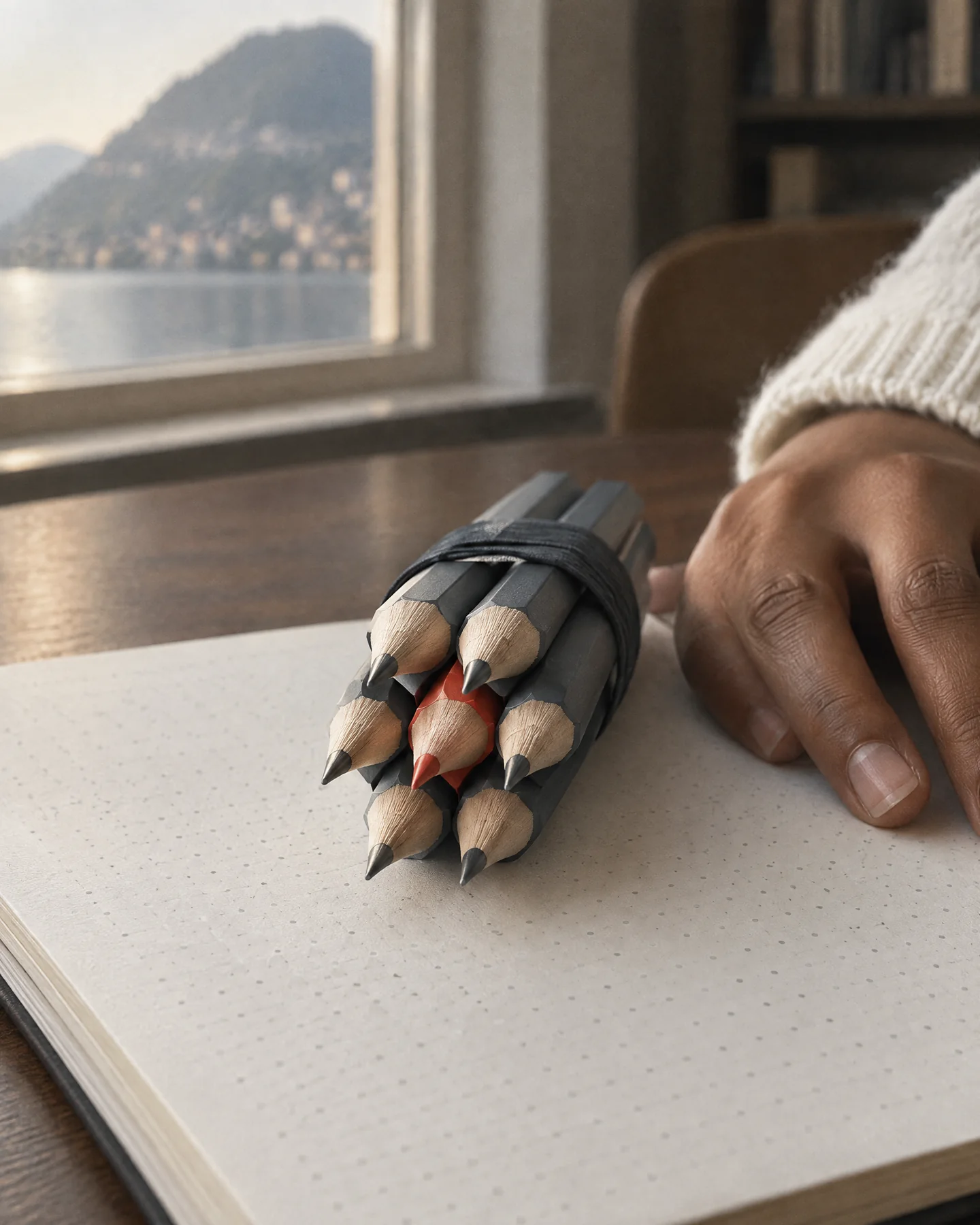
Seven hexagonal pencils in a bundle: six in graphite round one in red. It is the tightest way to pack them, and one of the reasons a pencil has six sides.
Round one coin you can lay exactly six of the same size, each touching it. Go on, and you have the densest packing of circles in the plane: it covers π/(2√3) of it, about 90.7%, a fact bees act on and one proved in full only in 1940. Hexagonal pencils go one better and leave no gaps. In three dimensions the number is twelve: twelve and one again.
See the objectFour brass dice with no best one
Two in Three
CHF 78
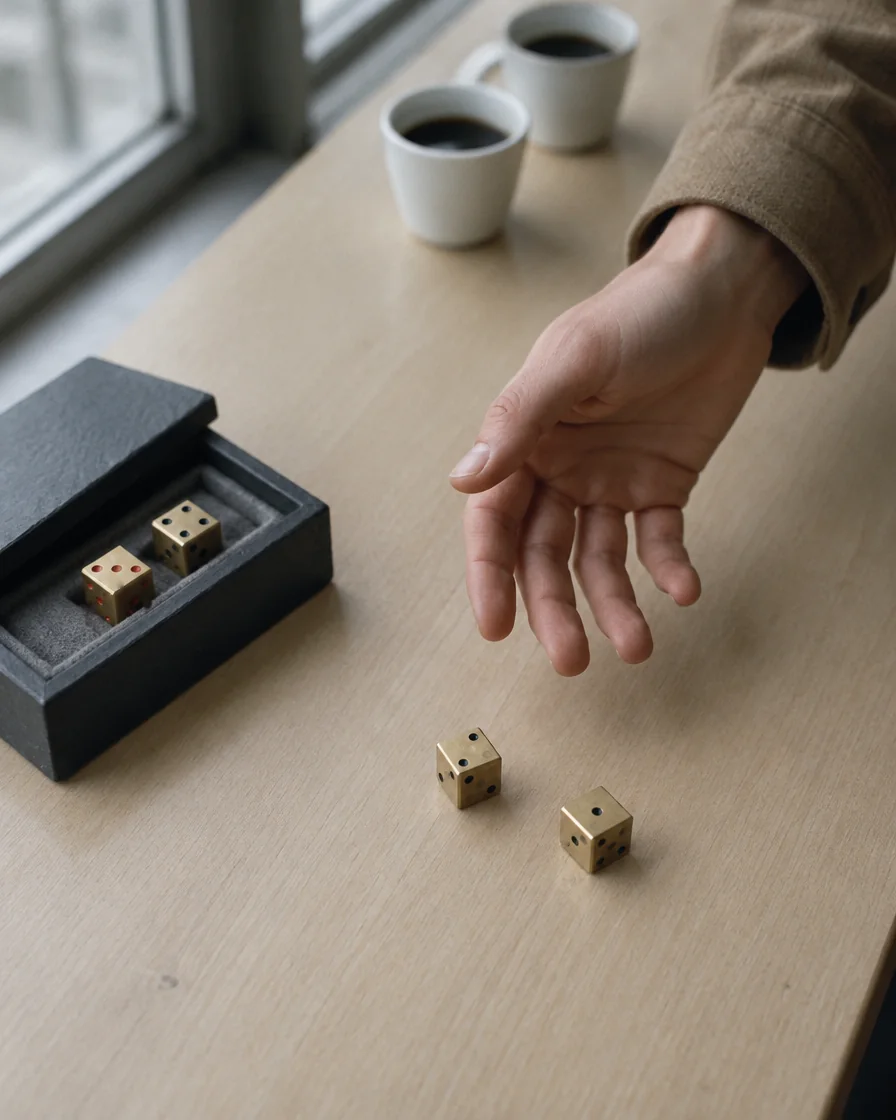
Four dice for settling who goes to the board, who referees the paper, who buys the coffee: each takes a die, both throw, the higher face wins. Let the other person choose first. Whichever die they take, one of the three that are left beats it two throws in three.
Efron’s dice: devised by the statistician Bradley Efron and made public by Martin Gardner in Scientific American in December 1970. A has the faces 4, 4, 4, 4, 0, 0; B, six threes; C, 6, 6, 2, 2, 2, 2; D, 5, 5, 5, 1, 1, 1. Of the 36 pairs of faces A beats B in 24, B beats C in 24, C beats D in 24 and D beats A in 24: winning is not transitive, there is no best die, only a best reply, and choosing first is the mistake. Four dice cannot do better all the way round: Zalman Usiskin proved in 1964 that two in three is their limit, that three dice stop at 0.618 and that no number of dice reaches three in four. It is a law of many throws, not of the next one: over twenty, the right die comes out ahead nine times in ten.
See the objectPocket rule in brass, also a bookmark
Four Notches
CHF 34
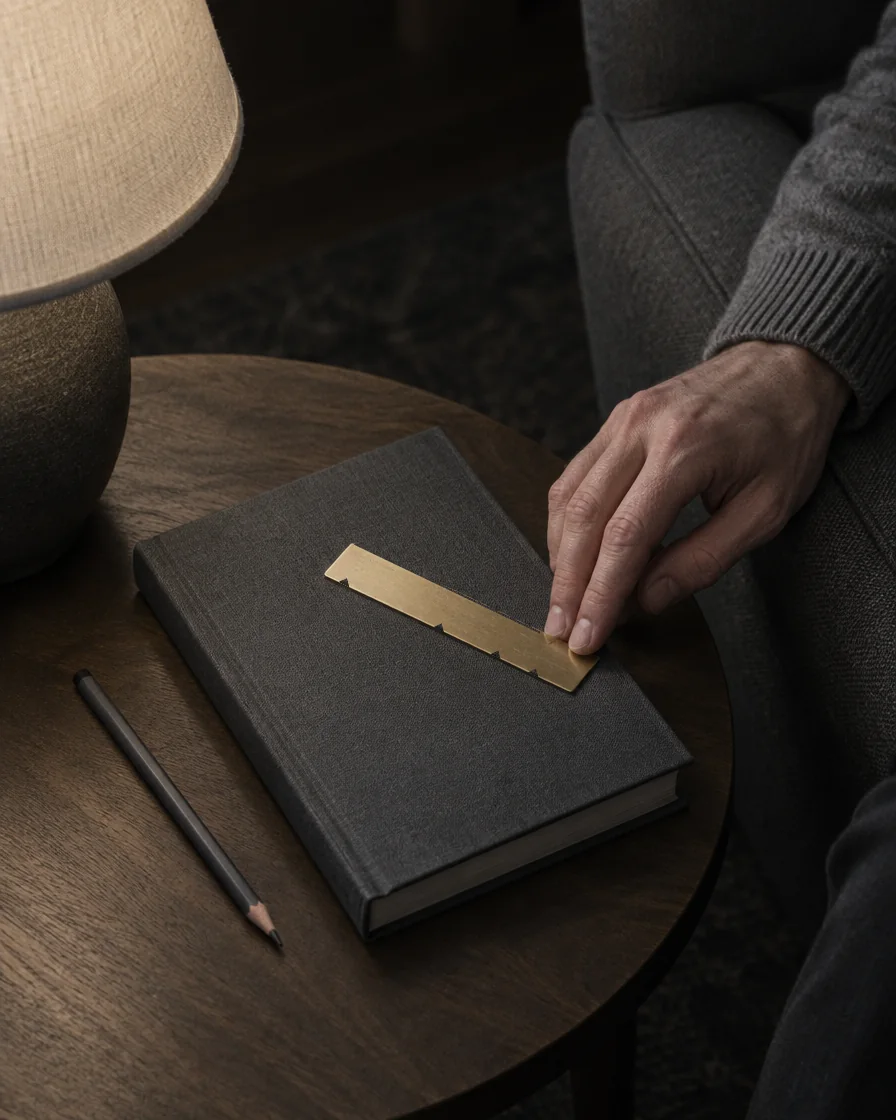
A strip of brass 13 cm long that keeps your place in a book and measures any whole number of centimetres from 1 to 13. It has six marks only, its two ends and four notches: find the pair the right distance apart.
A rule does not need a mark at every centimetre, only enough marks that every length lies between two of them. With marks at 0, 1, 6, 9, 11 and 13 nothing is missing: 7 is from 6 to 13, 10 is from 1 to 11. Six marks make fifteen pairs and thirteen lengths are wanted, so two pairs are spare: there are two ways to measure 2, and two to measure 5. Thirteen is the most that six marks can do, and five marks stop at nine: John Leech studied the problem in 1956, and the small cases are settled by trying every arrangement, which finds three such rules and their mirror images. A rule with nothing to spare, every length exactly once, exists only up to four marks, at 0, 1, 4 and 6; beyond that one settles for no length twice, which is a Golomb ruler, and a way of spacing the antennas of a radio telescope.
See the objectSolid brass spinning top
The Top
CHF 90
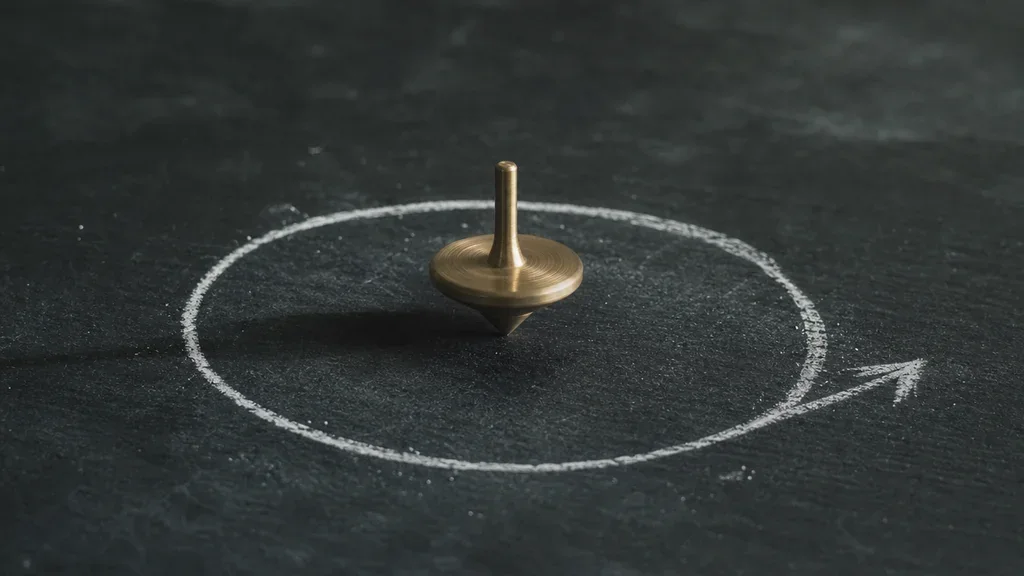
A small top turned from one piece of brass, with a stick of chalk to draw its circle. Spun hard it stands upright and looks asleep. It is not at rest: it stands only while it spins.
Five Eighths stands because it has nowhere lower to go. A top has, and stands anyway, but only while it spins: upright is stable for it above a certain speed (a² > 4 in the formula), and below that the smallest nudge grows. Leaning, a spinning top does not fall: gravity turns its axis sideways instead of down, and the axis goes slowly round the vertical, at a rate that goes as one over the spin, so the slower it spins, the faster it circles. Let go leaning and at rest, the axis also nods as it goes. Lagrange wrote the equations in 1788, and the figure is their solution, seen from above, for a top with nothing rubbing at its point, spinning 1.8 times as fast as it needs to sleep and let go at 12°: ten nods to one turn. Friction at the point soon rubs the nods out, and what is left is the red circle; watch it hurry as it tires.
See the objectDesk instrument in brass and walnut
Double Pendulum
CHF 270
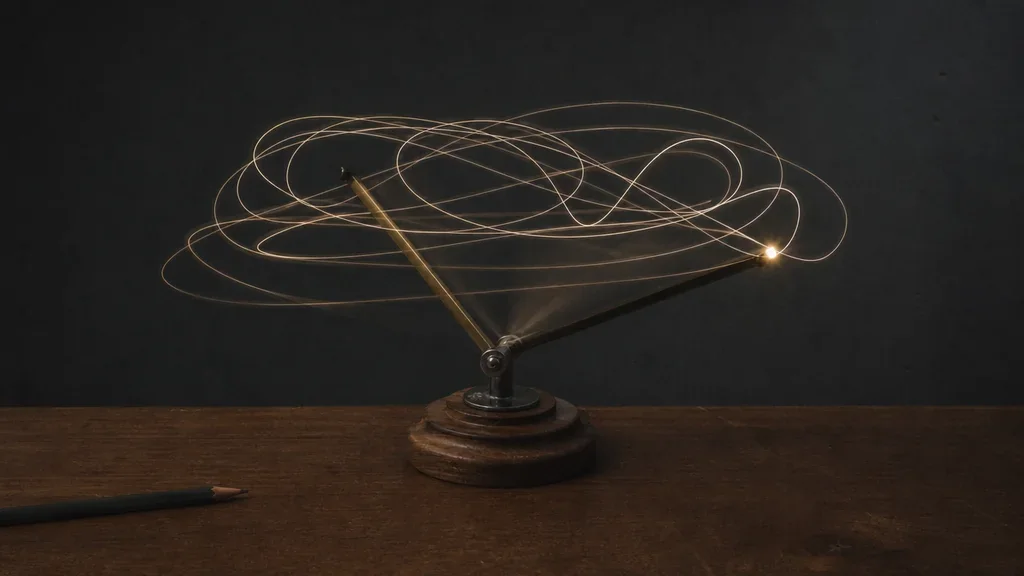
Two brass arms, one hung from the end of the other, on steel bearings over a walnut base, with a small lamp at the tip. Lift them and let go. Do it again from the same place, as nearly as a hand can: for half a second it repeats itself, then it does something else.
Nothing in it is random: two arms, two angles, two equations, and an energy that is conserved until the bearings spend it. For small swings it is tame: two modes, the arms together and the arms opposed, and every motion a sum of the two. Lifted high it is chaotic: the gap between two motions that begin a hair apart grows, on average, by the same factor in every equal time, so no hand lets go from the same place twice. Poincaré met this in the three-body problem in 1890; Lorenz found it in a model of the weather in 1963, and the Stadium Tray has it in its outline. Drawn here, for two equal bars: the path of the lamp, let go at rest with both arms 120° from the downward vertical, and again with the lower arm a hundredth of a radian further round, a little over a millimetre at the lamp. With arms of 125 mm that is one second: for the first half second the two lines are one, and by the end they are two arm’s lengths apart.
See the objectLogarithmic desk lens in crown glass
Eddington Lens
CHF 160
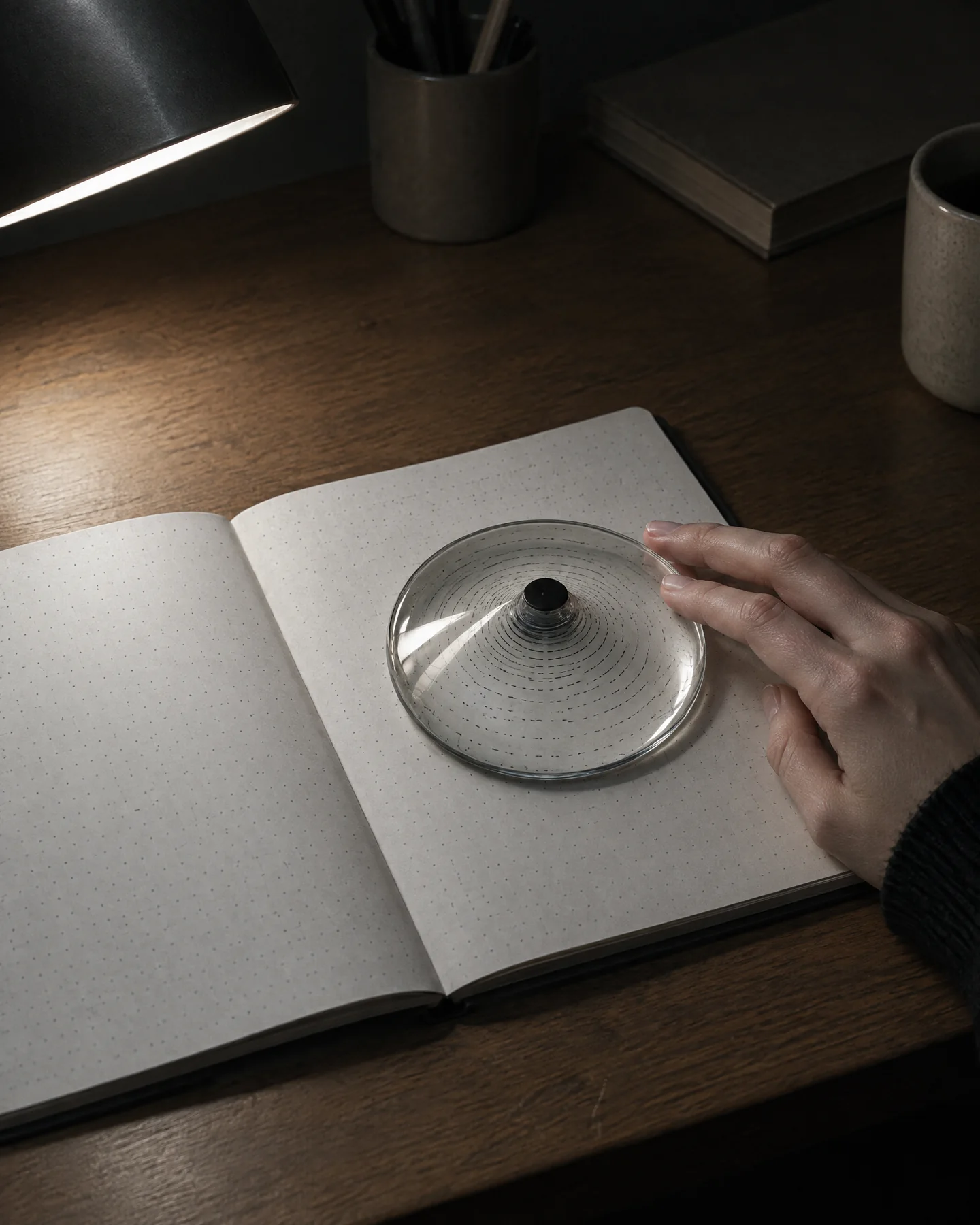
AION’s symbol is a black hole; this is as near as a desk comes to one. A lens shaped to turn light as a mass does: laid on the dot grid it pulls the lattice into arcs round a black centre, and a dot placed exactly behind the centre becomes a ring.
Light that passes a mass at a distance b, well outside it, is turned through a small angle, 4GM/c²b: twice what Newton’s gravity alone would give. Eddington’s expeditions measured it at the edge of the Sun during the eclipse of 29 May 1919. A lens whose thickness falls as the logarithm of the radius turns a ray by the same law, an angle proportional to 1/b: rays that pass closer cross the axis sooner, so there is no focus, only arcs and, when everything lines up, a ring. At the centre the logarithm would need infinite glass. We stopped there and put a black disc. A black hole does much the same.
See the object
A study, not yet a shop.
No object has been made yet: prices and materials are working values, and the photographs are generated images, studies for this page, not pictures of real objects or of real people. Nothing can be ordered yet, and the bag stays on your device.
Back to the wardrobe, or tell us which object should exist.