11:45, the desk, before lunch
The dip is a cycloid, the curve drawn by a point on a rolling wheel, turned upside down. Along a cycloid the height above the lowest point grows as the square of the distance still to run, so the pull back towards the bottom is exactly proportional to that distance: twice as far to go, twice the pull, the same time. Christiaan Huygens found it in 1659, looking for a clock that would keep time at sea, and printed it in 1673. A pendulum swings on a circle, where the same is only nearly true: let go as high as the rim of this track, a ball on a circle arrives about 2% late. A ball that rolls changes one number and nothing else, since rolling makes it 7/5 as hard to move on any track: the fall takes π√(7a/5g), a quarter of a second here, from any height. The same curve is the quickest way down, Johann Bernoulli’s challenge of 1696; and it is the Double Pendulum turned inside out: there the same start gives different ends, here different starts give the same end.
Objects · Cycloid track in walnut, two steel balls
Any Height
CHF 150 working price
For anyone sure that the higher ball arrives later: let both go, and listen for one click.
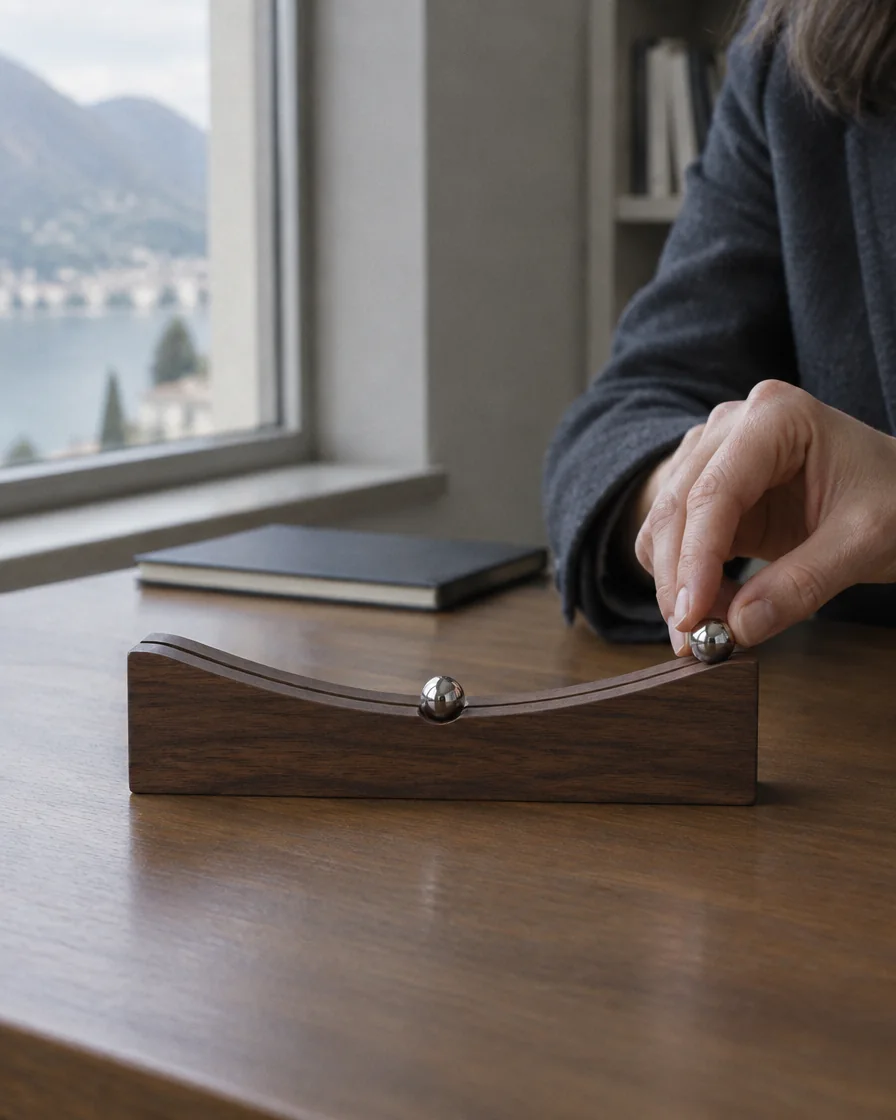
A block of walnut with a dip cut along its top edge, and two steel balls. Let one go from the rim and the other from anywhere lower on the other side: they meet at the bottom, every time. Left alone, one ball swings once a second, however small its swing has become.
A study: nothing can be ordered yet. The photograph is a generated image, not a picture of a made piece or of a real person.
- Walnut, oiled, 225 × 55 × 40 mm, about 200 g, felt underneath; two chrome-steel balls, 16 mm across, 16.7 g each
- Milled so that the centre of a ball runs on the cycloid of a rolling circle of radius 44.4 mm: the floor lies 8 mm outside that curve, since a parallel to a cycloid is not a cycloid, and the ball would know. 192 mm from rim to rim, 29 mm deep
- A flat-floored channel 17 mm wide keeps the balls on the track. Its floor is scraped smooth and left bare, with no oil or wax, so that they roll and do not skid, and the rims stop at a slope of 35°, the steepest on which a rolling ball can be trusted
- Cut for a swing of one second: a quarter of a second to the bottom from anywhere. A hairline of brass let into the wall marks the lowest point; two balls meet within half a ball’s width of it, since each reaches the other before it reaches the line
- Numbered underneath; a slate box lined in felt. Nothing on it is red