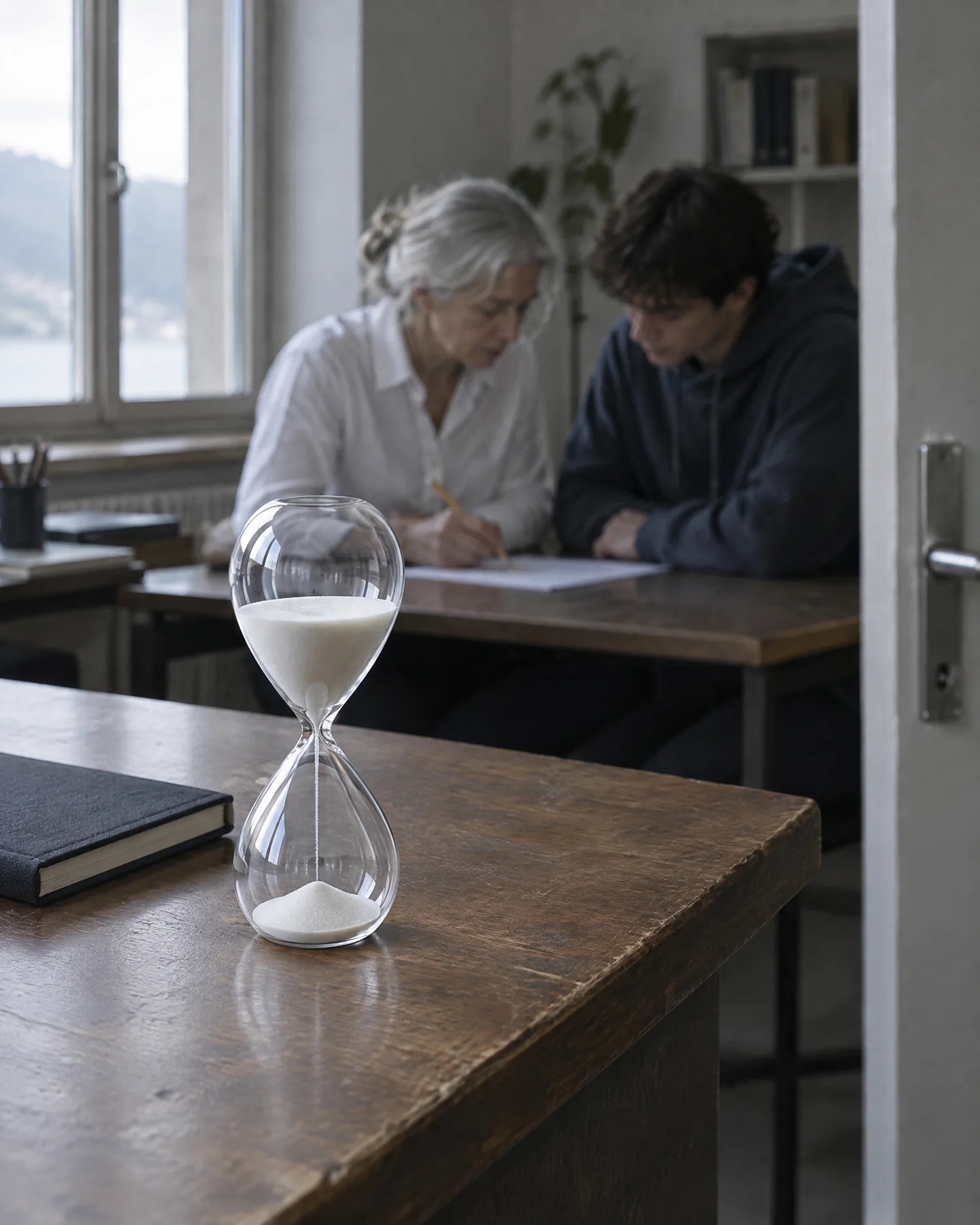
10:00, the office, door open
Water runs out of a vessel more slowly as its level falls: Torricelli, 1643. Sand does not. The grains above the neck lean on the glass and on one another, so the neck never feels the height of the column, and the flow depends on the width of the neck alone: Beverloo’s law, 1961. That steady flow is why half the sand is half the time. Drawn here: sand, the straight red line; and water in a straight-sided vessel that would empty in the same time, a parabola that agrees with the line only at the start and at the end.
Objects · Sand glass, 45 minutes
Office Hour
CHF 95 working price
For office hours, a talk or an exam: forty-five minutes you can read from the back row.
The academic hour is forty-five minutes. So is this: one piece of blown glass, chalk-white sand, nothing to wind and nothing to charge.
A study: nothing can be ordered yet. The photograph is a generated image, not a picture of a made piece or of a real person.
- Borosilicate glass, blown in one piece: 190 mm tall, 80 mm across, about 240 g; no frame, no base, no metal
- Runs 45 minutes, within one minute either way; each glass is timed, and its own time is written on the card in the box
- Glass beads of a single size, chalk white, so the level reads against a blackboard from the back row
- By Beverloo’s law the flow goes as the width of the neck, less about a grain and a half, to the power 5/2: the last tenth of a millimetre of the neck is worked by hand
- No numerals and no marks on the glass. Turn it over to start again