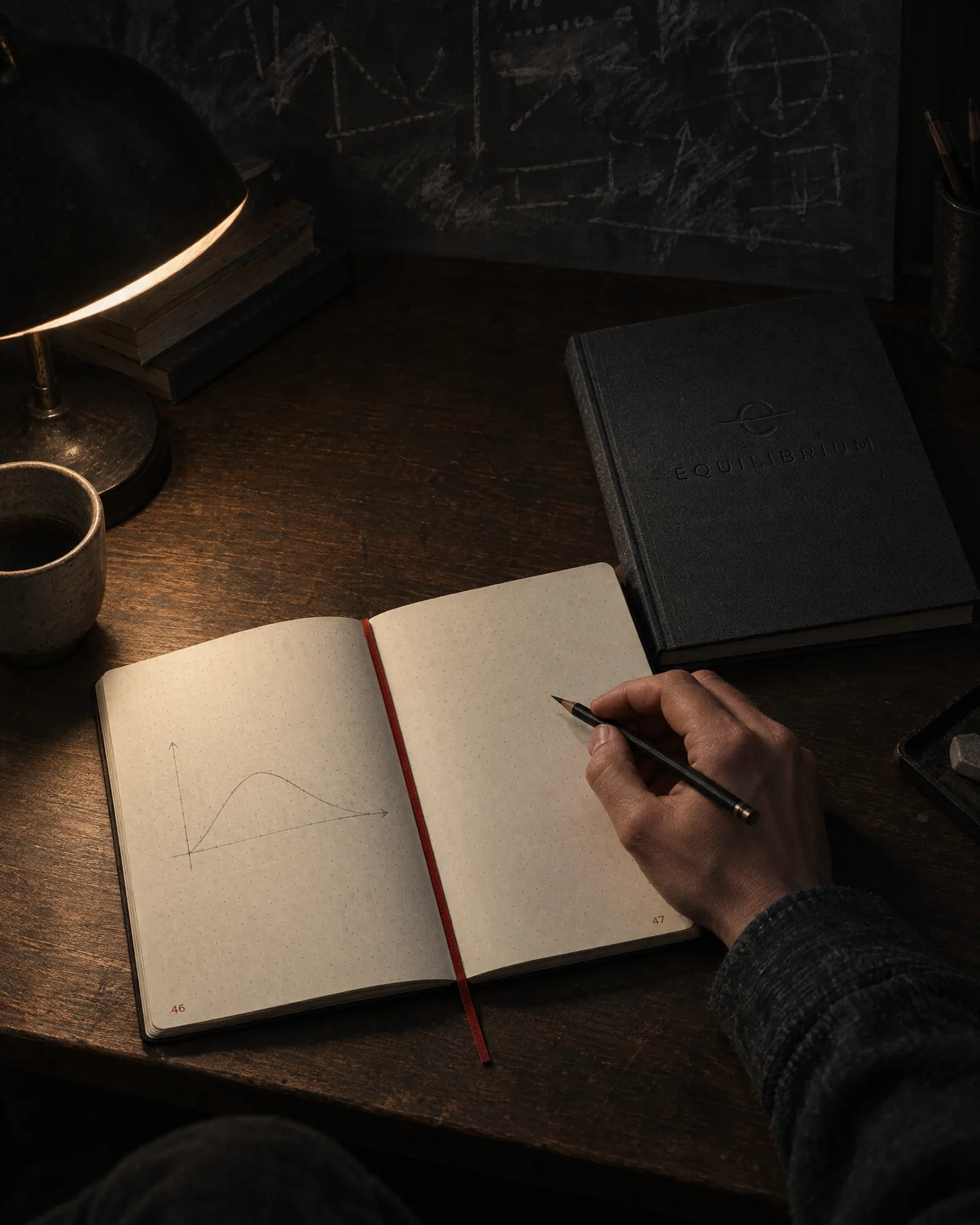
01:10, the same desk, the same lamp
Light that passes a mass at a distance b, well outside it, is turned through a small angle, 4GM/c²b: twice what Newton’s gravity alone would give. Eddington’s expeditions measured it at the edge of the Sun during the eclipse of 29 May 1919. A lens whose thickness falls as the logarithm of the radius turns a ray by the same law, an angle proportional to 1/b: rays that pass closer cross the axis sooner, so there is no focus, only arcs and, when everything lines up, a ring. At the centre the logarithm would need infinite glass. We stopped there and put a black disc. A black hole does much the same.
Objects · Logarithmic desk lens in crown glass
Eddington Lens
CHF 160 working price
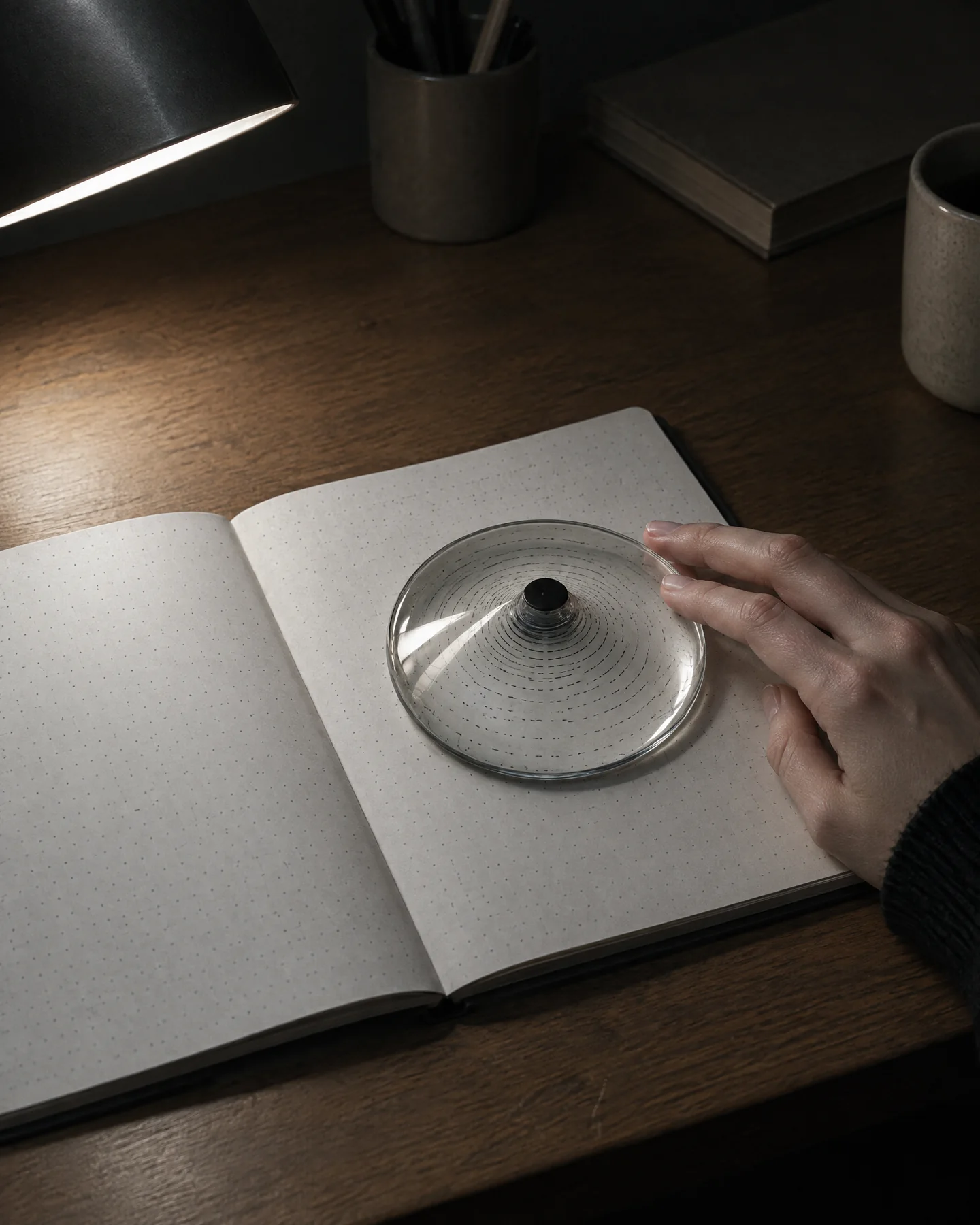
For the notebook at night: slide it over the dot grid and watch a straight line give way.
AION’s symbol is a black hole; this is as near as a desk comes to one. A lens shaped to turn light as a mass does: laid on the dot grid it pulls the lattice into arcs round a black centre, and a dot placed exactly behind the centre becomes a ring.
A study: nothing can be ordered yet. The photograph is a generated image, not a picture of a made piece or of a real person.
- Crown glass, moulded to the profile, ground flat underneath and polished: 80 mm across, 22 mm at its thickest, about 100 g; it slides on paper
- Logarithmic profile: the deflection falls as one over the distance from the centre, as round a point mass
- The centre is a flat black stop, 11 mm across, where the profile would run to infinity
- On the notebook’s dot grid it draws arcs; a single dot centred under it becomes a ring
- Numbered by engraving on the rim; a slate box lined in felt. AION’s object: nothing on it is red