17:00, the seminar room, time called
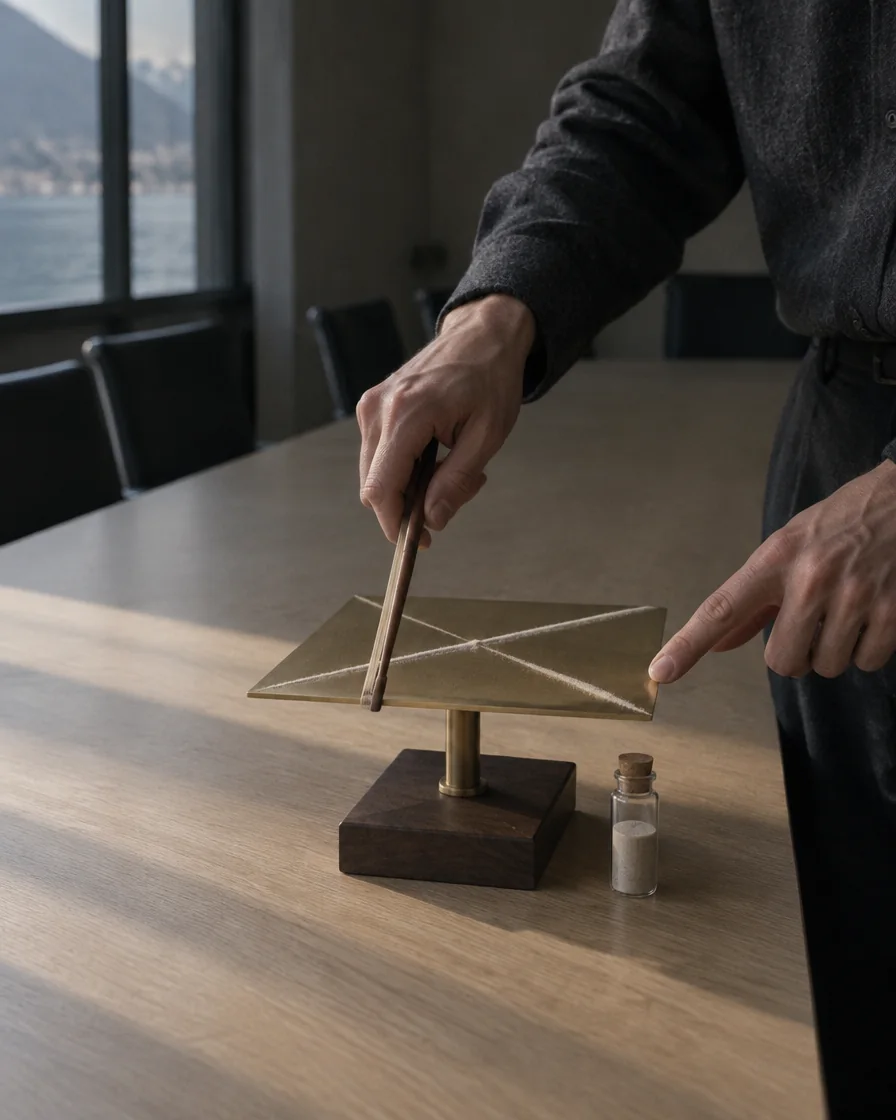
A plate sounding one note is a standing wave: parts of it rise while their neighbours fall, and between them run lines that do not move at all. Sand is thrown off whatever moves and comes to rest on those lines: Ernst Chladni showed it in 1787. A fingertip on the edge chooses the figure, by forbidding motion where it rests: bow the middle of a side with a finger on a corner and the sand draws the two diagonals; bow near a corner with a finger at the middle of a side and it draws an upright cross through the middles of the sides, a little under a fifth lower. Napoleon had the Paris Academy offer a prize for the theory: Sophie Germain won it in 1816, Kirchhoff set the edge conditions right in 1850 and Ritz computed this very plate in 1909. The formula here is the simplest with the right symmetry, exact for a plate whose edges may slide but not tilt and close for free ones; its red diagonals are exact for both, by symmetry alone.
Objects · Brass sounding plate, with bow and sand
Quiet Lines
CHF 240 working price
For calling time on a talk, and for seeing what a note looks like.
A square plate of brass on a post. Rapped with a knuckle it rings long enough to end a seminar. Dusted with sand and bowed on its edge it sings one note, and the sand runs to the lines where the plate is not moving.
A study: nothing can be ordered yet. The photograph is a generated image, not a picture of a made piece or of a real person.
- Plate of hard-rolled brass, 150 × 150 × 1.5 mm, about 285 g, flattened and left raw, its edges rounded for the bow; nothing is marked on it, and a sleeve wipes the figure off
- Held at its centre by one screw on a brass post 12 mm thick, over a walnut foot 110 mm square, weighted with steel, felt underneath: 120 mm tall, about 1 kg in all. The centre is at rest in both of the lowest figures, so the post disturbs neither
- In the box: a short bow in pear wood and horsehair, 35 cm; a cake of rosin; a glass vial of washed white quartz sand. Sand, not dust: anything as fine as chalk is carried by the air to where the plate moves most, as Faraday showed in 1831
- By plate theory its two lowest notes lie near 150 Hz (the cross) and 220 Hz (the diagonals); each plate is sounded before it leaves, and its own two notes are written on the card
- Numbered under the foot. Nothing on it is red